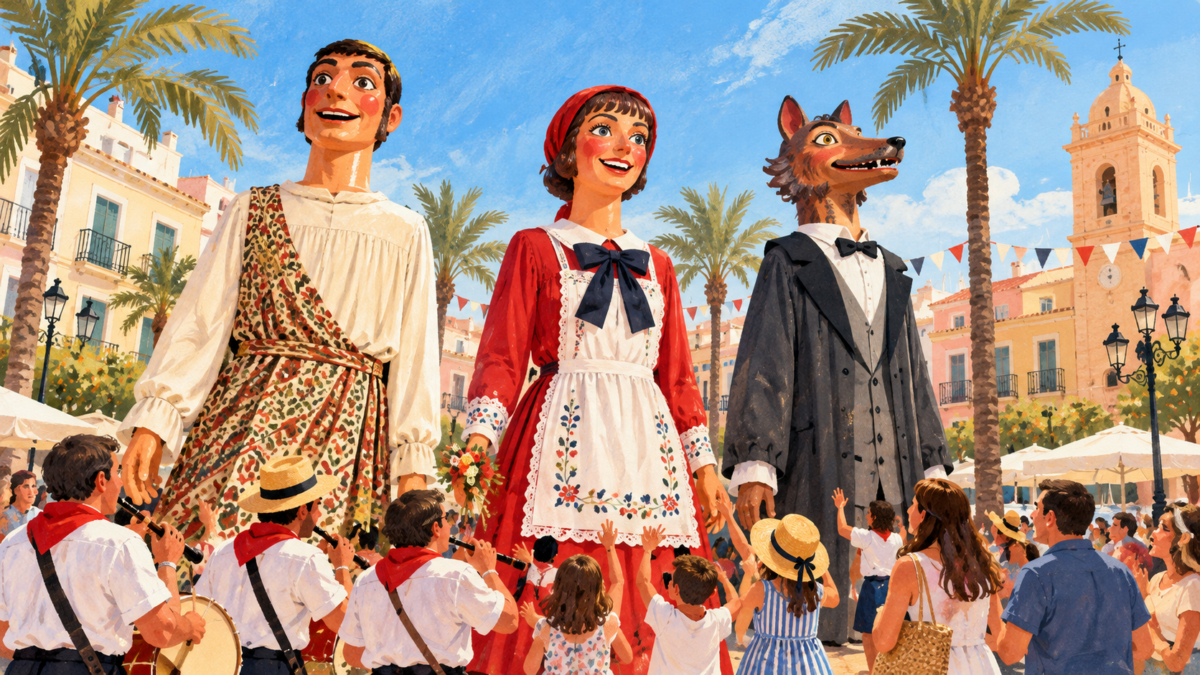
If you are in or around Torrevieja in December then you should be prepared for La charamita – a traditional celebration that is difficult for any outsider to interpret and confuses some locals too.
You could be minding your own business, walking through the Plaza de la Constitucion (town square) in the centre of Torrevieja, when, all of a sudden, you find yourself witness to one of the most puzzling processions you’ve ever seen. A river of ordinary citizens, from babies in pushchairs to grandparents, jostled between some huge effigies and accompanied by a loud and not particularly tuneful song.
This slightly bizarre but traditional event takes place during December as part of Torrevieja’s homage to its patron saint, La Inmaculada Concepción. Over the course of a week a mixture of religious ceremonies and fun, family events are scheduled. Most are what you might expect from a town’s annual patron saint celebration. However, the giants and big heads are something just a little different.
It’s hard to establish, as with many traditions, the authentic origin of this annual opportunity to be just a little irreverent – although it is rumoured to date back to medieval times. It centres around the main characters in the parade – Lily, el Lobo (the wolf) and el Ogro (the ogre). These ‘gigantes’ aren’t only giant by name but actually measure around four metres high.
Interspersed between them and the crowds are the ‘cabezudos’ which are in fact large paper-mâché heads balanced on people’s shoulders. It is quite a display as they emerge from the vicinity of the town hall every day over the course of the week and proceed to parade around the town to drums and pipes playing ‘Serafina la cochina’. The event is also replayed in some local schools as the characters are invited to create their own procession around the playground.
Torrevieja isn’t the only town in Spain where giants and big heads make an appearance. Gigantes and cabezudos can be seen as part of other traditional displays and processions and feature different sets of figures. In Pamplona there exists one of Spain’s best-known giant processions including kings and queens from different continents. In Zaragoza some of the figures have more of a local significance and can be traced back to people who actually lived in the city. In Valencia there is more of a religious theme with the characters representing the battle between good and evil.
In Torrevieja, however, we are still a little uncertain about the exact origins of our Lily, Lobo and Ogro. What does matter is that to the people of the town, the characters are greeted with warmth rather than fear. The tradition of children chasing after the parade and running around the streets, is one carefully preserved by those who remember doing the same in their own childhood.
AI-generated illustration inspired by the tradition of giants and big-head figures. It does not depict the actual characters of La Charamita.

It might be of your interest...



No comments yet
There are no comments on this post yet.
Leave a comment