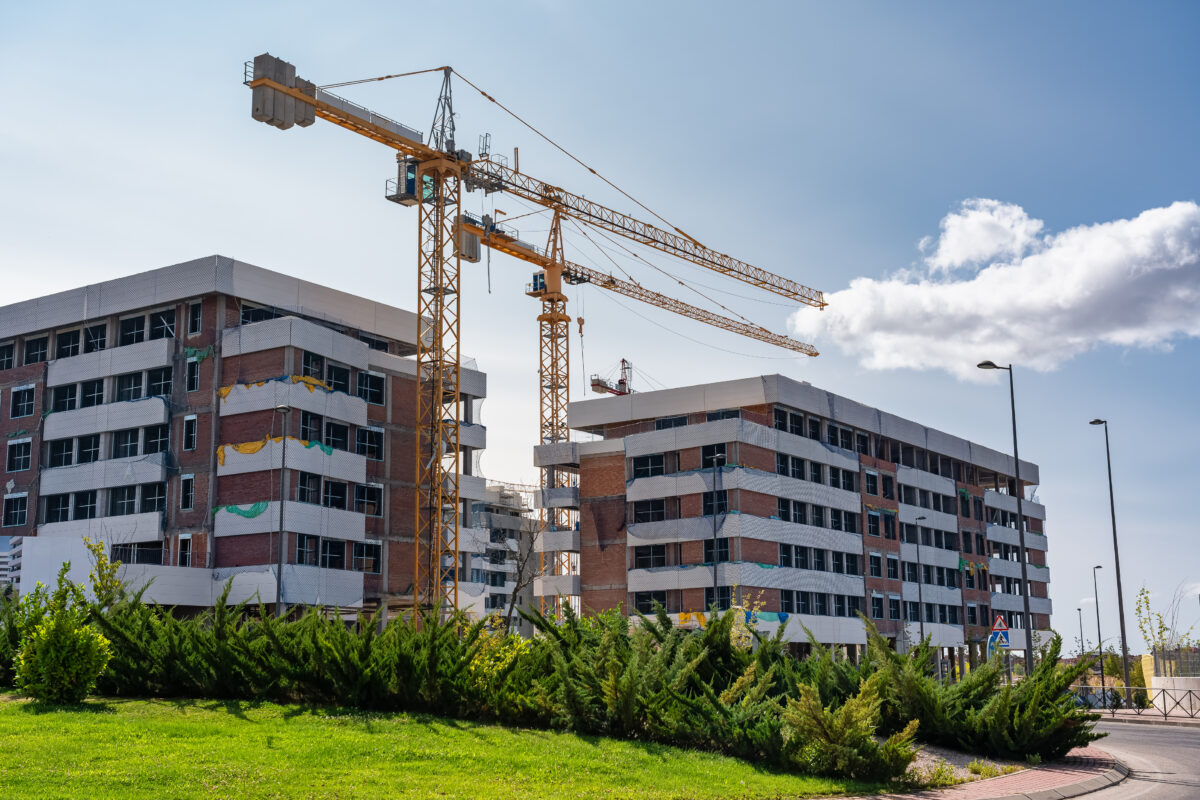
Spain’s economy is doing well in comparison to many other European countries. However, for the average person living in Spain it’s difficult to find an affordable property to rent or buy. Build more! Is the IMF’s advice. Would this solve the problem and if not, what will?
If you are landlord of a property in Spain then you may be feeling pretty confused at the present time. The ground seems to be constantly shifting in relation to what rental property owners are and are not allowed to do. The latest being the Supreme Court’s announcement that Spain’s national rental registry must be removed.
This and other measures, such as capping the number of short-term rentals in different regions, have been introduced largely in a bid to enable ordinary Spanish people to buy or rent property in line with their wages. An average take- home pay can be around 1,900€ with house rental touching on 1,000 € of that. At more or less 50% of available income, this is a sizeable chunk. Recommended housing cost is around 30-35% and some rental agencies require proof of income that reflects this.
What the International Monetary Fund (IMF) is saying is that the affordability issue needs to be addressed through increasing the new-build stock available rather than focussing on property rentals. The level of legal uncertainty is off-putting to those with the investment potential and the developers who could make a difference by building more. The demand is there but supply is lacking and current approaches will not help.
The IMF suggests that improving building-licence procedures and reducing legal uncertainty will enable faster urban development. The legal uncertainty they refer to is the clampdown on lettings being administered through changing the rules and regulations.
Whether any new-build will be in the price bracket of the average worker, is unlikely however and this still remains a problem. Spain does not have much public or social housing. Only 2.5% of housing stock comes into this category in comparison with a European Union average of 9.3%.
For those living in some urbanisations in Spain, there might appear to be another solution. In close proximity to some of the areas where houses are being built, there can be abandoned properties. These properties can become victim to squatters whose illegal possession of the property means that they are not contributing to the system which can create hostility in the local area.
The reasons these homes are abandoned can be complex but many are those previously owned by people who have since died and whose relatives, for whatever reason, have not completed the necessary property transfer paperwork. Some properties have huge debts held against them which no one wants to inherit and buildings fall into a spiral of neglect.
Most people agree, addressing affordable housing shortage in Spain is an urgent necessity. The issue of how this can be achieved is likely to be debated for some time to come.

It might be of your interest...



4 comments
1 July, 2026 1:57 pm
Local builders should be told to build more social housing and not concentrate solely on homes for overseas buyers at prices that the average Spanish employee cannot afford. Most of the builders in holiday areas are building expensive houses that only expats can afford and are left idle for most of the year.
14 July, 2026 8:54 am
We understand your point, and it is certainly true that affordable housing is an important issue in many parts of Spain.
At the same time, both types of development can play a role. Social and affordable housing is essential for local residents, while homes purchased by international buyers also contribute to the local economy through investment, taxes, employment, and spending on local businesses and services.
Ideally, there should be a balanced approach that increases the supply of affordable housing for local people while continuing to encourage responsible investment from overseas buyers. In the end, increasing the overall housing supply and ensuring a good mix of developments is likely to benefit everyone.
2 August, 2026 11:45 am
Hi Oscar, hope all is well with you. Is a new officially sponsored solution the placement of mobile homes on non-urban land? Next to our house outside Catral (which you helped us buy) the lanowner has placed two mobile homes, with families living there now. In other parts near us we can see mobile homes springing up. Some of these supposedly non-permanent buildings placed in the campo are probably on the 10000 sq metres we were required to purchase in order to build. But in some cases, they clearly exceed the 2% use limit we understood applied to building on a non-urban plot. I believe placing mobile homes requires planning permission from the local town hall – so back to my original question…are town halls alleviating the housing problem by approving mobile home placements where house building might otherwise be denied. Maybe an article on this for the magazine? Warm regards, David and Carol
5 August, 2026 4:23 pm
Dear Mr. and Mrs. Hubbard,
All good here, thank you. I hope all is well with you too.
Following your enquiry, after reviwing the matter with the legal department we would like to clarify the current situation regarding mobile homes on non-developable land in the Valencian Community.
There is currently no new regulation in the Valencian Community that generally allows mobile homes to be installed on non-developable land as a solution to the housing shortage.
Under Valencian planning legislation, residential use, whether permanent or temporary (for example, for weekends), requires the corresponding municipal planning authorisation. This means that prefabricated houses, mobile homes, permanently installed caravans and other removable structures are not exempt from planning permission simply because they are not traditional or permanent buildings.
In fact, Article 232 of the Valencian Urban Planning Law (TRLOTUP) expressly establishes that the placement of prefabricated houses and similar installations, whether temporary or permanent, is subject to planning permission.
Furthermore, the Spanish Supreme Court has confirmed that mobile homes should be treated as dwellings rather than simply as trailers or vehicles when their intended purpose is residential use. Consequently, their installation is subject to planning control and must comply with the applicable regulations and the requirements established by the relevant Town Hall.
It is true that there appears to have been an increase in this type of installation in certain areas of the Vega Baja. However, this does not necessarily mean that there is any municipal or regional policy allowing or facilitating their installation as a way of addressing the housing shortage. Each case must be assessed individually and must have the corresponding planning authorisation.
Therefore, the cases you mention would, in principle, be subject to the corresponding municipal planning licence. If you are concerned about the mobile homes installed by your neighbour, it would be possible to report the situation to the Town Hall and request that they investigate whether the necessary licences and authorisations have been obtained.
It is possible that the Town Hall has not taken any action on its own initiative to date. However, once a formal complaint is submitted, the Town Hall would need to investigate the situation and, if the installations are found to be unauthorised, take the appropriate enforcement measures in accordance with the applicable legislation, which could include sanctions and, where legally applicable, removal or demolition.
I hope the above clarifies the situation. Should you need anything else do not hesitate to contact us.
Kind regards,
Oscar Paoli
Ábaco Advisers
Leave a comment